In my last blog entry, you were able to hear my great-grandmother's account of how her father, John E. Feero, lost his life on the White Pass near Skagway in 1898. Thanks to my cousin in Calgary, Jo-Ann Larson, I was able to recently also get a look at an article that recounted his death in a local Maine newspaper, the Lewiston Evening Journal (John and his wife were raised in the area before heading west and then north). She was able to send me an image of part of the page that featured the article from 1898. Amazingly, I was able to find the entire article in an online archive (click here for it!). To make things easier to read, I have retyped the full article below. It's very interesting and as you'll notice, the person who wrote the headlines and caption misspelled Feero with one "e" while the article writer made no such mistake. The article and the letter featured in the article really brings home the tragedy that the family felt for this loss.
 |
| Portrait of John Feero and his wife with his name misspelled. |
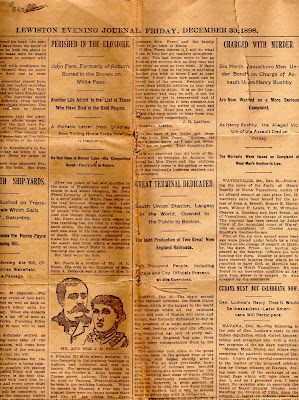 |
| The original article in the Lewiston Evening Journal. |
From the Lewiston Evening Journal, Friday, December 30th, 1898
Perished in the Klondike
John Fero (sic), Formerly of Auburn, Buried in the Snows on White Pass
--
Another Life Added to the List of Those Who Have Died in the Gold Region
--
A Pathetic Letter from Skaguay Post Telling Home Folks How it Happened
--
He Had Been to Bennet Lake - His Companions Save - Fero’s (sic) Life in Auburn
———-
After ten years of toll and sacrifice in the state of Washington and the gold mines in and about Skaguay, Mr. John Feero, formerly of Auburn, has perished in a snow storm at White Pass while on the trail between Skaguay and Lake Bennett, adding another to a long list of people who have lost their lives in that rich though rough country.
Mr. Feero and the man with whom he was traveling with lost the trail in a blinding snow storm. he fell through exhaustion and was soon in his last sleep-the sleep of death. His companion managed to make his way to a camp where he gave the alarm and from which a searching party at once went forth in the hope of rescuing the poor man alive.
But they were too late.
—
Mr. Feero is a brother of Mr. H. E. Feero. His wife is the daughter of Julia A. Babcock and a sister of Mrs. S. S. Perkins, 317 Main street, Auburn. He was formerly in the trucking business in Auburn and Lewiston and was well known. For several years he lived in one of the George A. Allen houses on Turner street, Auburn. Ten years ago he went to Tacoma, Washington, where he was in the trucking business. When he moved to Skaguay a year ago last August there were no frame house there and like all the other Mr. Feero and his family lived in tents and log cabins. At Skaguay his business has been that of carrying supplies between there and Lake Bennet, on the backs of horses. At times he has had 60 horses in the work and many men. He has done a prosperous business and has invested considerable money in Skagway read (sic) estate and in mining property farther up the line. The distance from Skaguay to Lake Bennett via the White Pass is 40 miles. A railroad is building between Skaguay and Lake Bennett but has only been completed as far as White Pass. Mr. Feero’s wife, Emma G. Feero has shared her husband’s trials and has been deeply interested in all of his ventures. That she is a brave woman goes without saying. She is the mother of four children: Willie, aged 15; Frank, aged 9, and twin girls, Edith and Ethel, aged 11.
—
The sad news of Mr. Feero’s death came to Mrs. Babcock, Dec. 29, in a letter from Mr. J. D. Laidlaw of Tacoma, Washington, a friend of the family, who has been in Skaguay for awhile. His letter is as follows:
Skaguay, Alaska, Dec. 12, 1898-
Mrs. Julia Babcock, Auburn, Maine.
Dear Friend: I often promised and intended to write to you but my unsettled condition and restlessness prevented me, but at this time I could not refuse Mrs. Feero’s request or delay a single boat. Poor woman, she has received a terrible blow and may God help her to bear up for her children’s sake.
John went over to Bennett on some business and in coming back he lost his life on the summit of White Pass. They took dinner at Little Meadows on Tuesday, Dec. 6 and stated home. It was storming hard, wing and snow from the south. Not severely cold temperature, about freezing, but they were facing the storm and it was very hard traveling. Near the foot of the Summit they met a park train and were advised to turn back, but being anxious to get home and he and his companion, Mr. Aimery, having crossed so many times, thought they could make it and pushed on. They had one horse which they rode in turn. The snow drifts so fast there that the trail was soon covered and there are no land marks, so they lost their bearings. The horse lost the trail too and in looking around to find the trail they lost the horse. Mr. Feero was complaining of terrible pains and finally gave out. Mr. Aimery carried him on his back for a while, then darkness overtook them and they beat down a place in the snow and tried to keep moving until day light. Then they started again. At 2 o’clock on Wednesday the 7th of December, Mr. Aimery managed to get into camp 11 of the railroad, about two miles from the trail. he was almost exhausted and out of his mind but he told the men in camp that he had left a man a short distance behind completely exhausted. A relief party immediately set out, but it was too late. Poor John was lying peacefully asleep in the snow. The sleep that knows no awakening in this world. McDonald, a packer who worked for John all summer and myself set out for the summit at once and with the assistance of six railroad men, brought the remains to White Pass and from there they were brought by train.. the funeral was held yesterday, Sunday, from Union church. Mr. Sinclair, the Presbyterian minister conducted the services. There was quite a large turnout and everything was done that willing hands and warm hearts could do, but there is so little that we can do. If we could only take a part of the sorrow and loneliness from those who are left and bear it for them.
As soon as the affairs can be straightened out, probably by the middle of January, Mrs. Feeo and the family want to go back to Maine.
If Mrs. Feero desire it, I will do what I can to help her get matters straightened out. You had better write to her as soon as you receive this, as they may not get away as soon as they wish. if there is anything I can do for you or anything further you wish to know I am at your service. I don’t know how much can be saved out of the wreck. Probably not more than $1000. In addition to that they have a claim in Attin.It is on the London market and may be sold, if not we will have to get it represented and if worth while develop it next summer. Am very sorry to be the writer of such sad news to you. Hope you are well and would like very much to hear from you. I remain yours respectfully,
J.D. Laidlaw
Skaguway, Alaska.
____
On the back of the letter are these words from Mrs. Feero: “Mother, let John’s folks know as I can not write. Oh, I am so lonely. Your daughter, Emma.”
It is not expected that the body of Mr. Feero will be brought to Auburn for burial but Mrs. Feero and the children will probably come in the spring or sooner if her husband’s business matters can be arranged.


