Showing posts with label Edith Feero. Show all posts

Sunday, December 19, 2021

The 100th Anniversary of Great Grandpa Karl Becoming an American Citizen!

 100 years ago today, on December 19th, 1921, my great grandfather Karl Larson received his citizenship and became a full-fledged American. Karl came from a small town in Sweden and, after landing in New York, eventually found his way to the small Alaskan town of Skagway. It was there where he would eventually marry my great grandmother Edith Feero and make a life for himself while working as a carpenter for the White Pass & Yukon Railroad. Although I’ve shared it before, here is the certificate of his citizenship (below) and my favorite photo of him (above) with my grandfather Tex in 1946 while working on the railroad. 


Saturday, February 13, 2021

Remembering My Father, Karl De Haven: 1936 - 2021


My dad in Skagway, Alaska.
In front of his home in Arcadia, CA.

This site, dedicated to my family's history, is usually filled with accounts of relatives who passed away long, long ago. Unfortunately, today's entry is dedicated to my father, Karl Michael De Haven, who passed away in his sleep just last Friday on February, 5th, 2021. He was just a couple months short of his 85th birthday. 

Born in 1938 as the second child of Jim Hartley and Urania (Rainie) Larson (daughter of Edith Feero), my dad’s life kind of got off to a rough start actually. Unfortunately for the family, Karl’s birth father Jim turned out to have an alcohol problem and was apparently abusive. The final straw was when, while drunk, he shot a gun off, narrowly missing hitting Urania in the stomach while she was pregnant with my father. Urania then left Jim and soon after (how soon is hard to calculate) married Vernon De Haven. Some time later Jim came back to try and take back his firstborn daughter Joyce but was prevented from doing so. He was allowed to visit the kids once on the condition that he not reveal that he was the children’s father. Although Joyce disputes that Jim didn’t want Karl, my father still mentioned the pain of this perceived rejection toward the end of his life. He also expressed great gratitude that his step-father (who he called “Tex”) had saved the family from a horrible situation. (Interestingly, Tex first dated Urania’s sister Ellen for a time) His grandfather Karl (his namesake) also did well to prevent Jim from taking back the kids. (Actually, because he shared his name with his grandfather, my father was called by his middle name “Mike” inside the immediate family)

My dad with his sister Joyce in Skagway.

After a few years in Skagway, my father and his family moved to Anchorage where Tex worked for Alaska Railroad. By then he had two little brothers (by Tex); Roy and Pat. After getting kicked out of University of Alaska Fairbanks (for, as my dad described it, “being at the wrong party”) he made his way to University of Western Kentucky where he would graduate with a BA. (He also later obtained an MA from USC) To support himself through college he worked at fish canneries in Alaska. Eventually after working as a surveyor (for the military building bases),a forrest ranger, and some other odd jobs he started his career as a teacher. It was as a teacher at Ursa Major Elementary School where he was introduced by his best friend Charlie to his future wife (my mother) Mary Hennessy. The two married in 1967 and then made the long trek down the Great Alaska Highway to her native Southern California (she was originally from Long Beach).

My dad and mom at their wedding (1967).

The couple first settled in Mission Viejo but were unable to find teaching positions close by. Tired of the long commute to Pasadena (where my dad taught) and Arcadia (where my mom taught) they moved to Arcadia, where they remained for good. By then, my brother (who was born while they were living in Mission Viejo) and I (born in Pasadena after the move to Arcadia) were in the picture and our family (plus or minus many cats and one poodle) was complete.

My dad would end up teaching science and math in Madison Middle School in the inner city for many years before moving on to Wilson Middle School (located much closer to Arcadia, just over the border in neighboring Pasadena). He was also extremely active in the MESA program at Cal State LA. The MESA program helps educationally underprivileged kids excellent at math, engineering, and science, helping many become the first in their family to go on to college. In the summers, my dad would also teach oceanography at Baldwin Stocker Elementary in Arcadia. This was where I had the unusual opportunity to be a student in my dad’s class. His influence on his students was great. For many, many years, it seemed that we would run into his former students working somewhere. To them, he was always know as “Mr. D.”

One of my father's school portraits.
As a person, my dad was a very friendly, talkative guy. As my aunt described, to him there were no strangers, only friends he hadn’t yet met. As a child, this habit of him striking up conversations with any and everyone could be sometimes embarrassing (I later heard that his mother was the same way). We often joked in the family, that someday he might accidentally start a conversation with a serial killer with a line like, “That’s a nice knife you’ve got there.” He was good natured and loving, never hesitating to express his feelings for me whenever I called him up from Japan. He also loved to laugh. His favorite tv show of all time was probably MASH. At night, while typing his lesson plans out he would watch the show from 11 to 12, his “holy hour” as he called it. He was a bit clumsy (although he was a very good bowler for many years, winning trophies while in Alaska) and sometimes sloppy with his clothing (mom did her best to keep him looking good). He was also an excellent cook, preparing almost all of our meals at home and only relinquishing the kitchen when grandma Rainie would come to visit. I often remember him falling asleep snoring in front of the tv only to wake up when I would change the channel. "Snore-snort, I was watching that." He was horrible with names, often confusing Hershiser with Kershaw when talking to me about the Dodgers ("Dad, Orel has been retired for like 20 years!"). 

Karl bowling as a youth.

As a father, he made sure to take my brother and I to the kind of events his father never took him to. He took my brother many times to see the Dodgers in Chavez Ravine and helped out with his little league team (I was horrible in sports and lasted only one season in t-ball). He took both of us to the LA Olympics in 1984. My brother lucked out by going to a soccer game. I was taken to the much more difficult to understand archery (can you name one famous archer besides Robin Hood??). Still, it was a great memory. Later in life, as I got into pro-sports, I would end up taking him to many hockey, baseball, soccer, and basketball games. Toward the end however, with his decreased mobility, it just became too hard to take him to a game whenever I visited from Japan, leaving me to go alone unfortunately.

My brother, dad, and I after little league.

Sometimes, my dad wasn’t the best at speaking clearly. One funny memory was when we were in the car as a family and he noted that he once had two dogs named “Peanuts and Popcorn” except every time he said peanuts, it sound like “penis.” Surprised by his choice of a name, I kept on asking him “did you really name your dog penis?” He would say yes and repeat the name while mispronouncing it. The more I asked to confirm, the more my mother would laugh, making him angrier because he didn’t understand what was so funny. I think the misunderstanding got cleared up when I asked him to spell it out. 

Karl with one of his dogs.

Retired life wasn’t too kind to my dad. A myriad of health problems (back, legs, shoulder, heart) limited his mobility, eventually forcing him to live the last six to seven years of his life at a rehab facility.  across from Santa Anita race tract in Arcadia, just a few minutes from his house. I would have loved to have him visit me in Japan. It would have been great to see how he would react to such a foreign place and have the chance to see a baseball game in Japan. I also really wish he could have spent more time with his grandchildren. The distance and cost worked against us there. We were able to bring over Yuzuru, my first born, three times and Fumi, my second, once but because of the pandemic, my dad was robbed of a chance to meet his granddaughter Willow (born last February). Damn that virus. Although it’s nice to think he is watching down on her now I would have loved to capture the expression on his face when he was able to meet her in person. 

Karl and his grandson, Yuzuru.
My dad with his first grandson, Yuzuru.
My dad with Fumito, his second grandson.

He was a great father, husband, and person that I and many people will miss dearly. He is survived by his wife, Mary, his two sons, John (JP) and Shawn (myself), his older sister, Joyce, younger brother, Pat, and his three grandchildren (Yuzuru Alistair (5), Fumito Sebastian (4), and Sumire Willow (11 months)). If you have a story to share about him I’d love it if you share it in the comments section.

Thursday, July 23, 2020

Perished in the Klondike: An Account of John E. Feero's Death From a Local Maine Paper in 1898

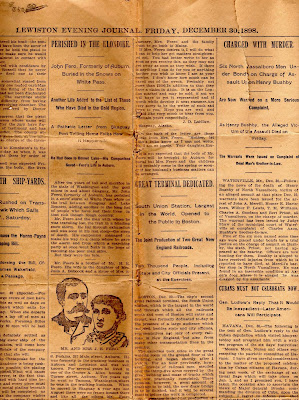
In my last blog entry, you were able to hear my great-grandmother's account of how her father, John E. Feero, lost his life on the White Pass near Skagway in 1898. Thanks to my cousin in Calgary, Jo-Ann Larson, I was able to recently also get a look at an article that recounted his death in a local Maine newspaper, the Lewiston Evening Journal (John and his wife were raised in the area before heading west and then north). She was able to send me an image of part of the page that featured the article from 1898. Amazingly, I was able to find the entire article in an online archive (click here for it!). To make things easier to read, I have retyped the full article below. It's very interesting and as you'll notice, the person who wrote the headlines and caption misspelled Feero with one "e" while the article writer made no such mistake. The article and the letter featured in the article really brings home the tragedy that the family felt for this loss. 


Portrait of John Feero and his wife with his name misspelled.
The original article in the Lewiston Evening Journal.

From the Lewiston Evening Journal, Friday, December 30th, 1898

Perished in the Klondike

John Fero (sic), Formerly of Auburn, Buried in the Snows on White Pass
--
Another Life Added to the List of Those Who Have Died in the Gold Region
--
A Pathetic Letter from Skaguay Post Telling Home Folks How it Happened
--
He Had Been to Bennet Lake - His Companions Save - Fero’s (sic) Life in Auburn
———-
After ten years of toll and sacrifice in the state of Washington and the gold mines in and about Skaguay, Mr. John Feero, formerly of Auburn, has perished in a snow storm at White Pass while on the trail between Skaguay and Lake Bennett, adding another to a long list of people who have lost their lives in that rich though rough country.
Mr. Feero and the man with whom he was traveling with lost the trail in a blinding snow storm. he fell through exhaustion and was soon in his last sleep-the sleep of death. His companion managed to make his way to a camp where he gave the alarm and from which a searching party at once went forth in the hope of rescuing the poor man alive.
But they were too late.
—
Mr. Feero is a brother of Mr. H. E. Feero. His wife is the daughter of Julia A. Babcock and a sister of Mrs. S. S. Perkins, 317 Main street, Auburn. He was formerly in the trucking business in Auburn and Lewiston and was well known. For several years he lived in one of the George A. Allen houses on Turner street, Auburn. Ten years ago he went to Tacoma, Washington, where he was in the trucking business. When he moved to Skaguay a year ago last August there were no frame house there and like all the other Mr. Feero and his family lived in tents and log cabins. At Skaguay his business has been that of carrying supplies between there and Lake Bennet, on the backs of horses. At times he has had 60 horses in the work and many men. He has done a prosperous business and has invested considerable money in Skagway read (sic) estate and in mining property farther up the line. The distance from Skaguay to Lake Bennett via the White Pass is 40 miles. A railroad is building between Skaguay and Lake Bennett but has only been completed as far as White Pass. Mr. Feero’s wife, Emma G. Feero has shared her husband’s trials and has been deeply interested in all of his ventures. That she is a brave woman goes without saying. She is the mother of four children: Willie, aged 15; Frank, aged 9, and twin girls, Edith and Ethel, aged 11. 
—
The sad news of Mr. Feero’s death came to Mrs. Babcock, Dec. 29, in a letter from Mr. J. D. Laidlaw of Tacoma, Washington, a friend of the family, who has been in Skaguay for awhile. His letter is as follows:
Skaguay, Alaska, Dec. 12, 1898-
Mrs. Julia Babcock, Auburn, Maine.
Dear Friend: I often promised and intended to write to you but my unsettled condition and restlessness prevented me, but at this time I could not refuse Mrs. Feero’s request or delay a single boat. Poor woman, she has received a terrible blow and may God help her to bear up for her children’s sake.
John went over to Bennett on some business and in coming back he lost his life on the summit of White Pass. They took dinner at Little Meadows on Tuesday, Dec. 6 and stated home. It was storming hard, wing and snow from the south. Not severely cold temperature, about freezing, but they were facing the storm and it was very hard traveling. Near the foot of the Summit they met a park train and were advised to turn back, but being anxious to get home and he and his companion, Mr. Aimery, having crossed so many times, thought they could make it and pushed on. They had one horse which they rode in turn. The snow drifts so fast there that the trail was soon covered and there are no land marks, so they lost their bearings. The horse lost the trail too and in looking around to find the trail they lost the horse. Mr. Feero was complaining of terrible pains and finally gave out. Mr. Aimery carried him on his back for a while, then darkness overtook them and they beat down a  place in the snow and tried to keep moving until day light. Then they started again. At 2 o’clock on Wednesday the 7th of December, Mr. Aimery managed to get into camp 11 of the railroad, about two miles from the trail. he was almost exhausted and out of his mind but he told the men in camp that he had left a man a short distance behind completely exhausted. A relief party immediately set out, but it was too late. Poor John was lying peacefully asleep in the snow. The sleep that knows no awakening in this world. McDonald, a packer who worked for John all summer and myself set out for the summit at once and with the assistance of six railroad men, brought the remains to White Pass and from there they were brought by train.. the funeral was held yesterday, Sunday, from Union church. Mr. Sinclair, the Presbyterian minister conducted the services. There was quite a large turnout and everything was done that willing hands and warm hearts could do, but there is so little that we can do. If we could only take a part of the sorrow and loneliness from those who are left and bear it for them.
As soon as the affairs can be straightened out, probably by the middle of January, Mrs. Feeo and the family want to go back to Maine.
If Mrs. Feero desire it, I will do what I can to help her get matters straightened out. You had better write to her as soon as you receive this, as they may not get away as soon as they wish. if there is anything I can do for you or anything further you wish to know I am at your service. I don’t know how much can be saved out of the wreck. Probably not more than $1000. In addition to that they have a claim in Attin.It is on the London market and may be sold, if not we will have to get it represented and if worth while develop it next summer. Am very sorry to be the writer of such sad news to you. Hope you are well and would like very much to hear from you. I remain yours respectfully,
J.D. Laidlaw
Skaguway, Alaska.
____
On the back of the letter are these words from Mrs. Feero: “Mother, let John’s folks know as I can not write. Oh, I am so lonely. Your daughter, Emma.”
It is not expected that the body of Mr. Feero will be brought to Auburn for burial but Mrs. Feero and the children will probably come in the spring or sooner if her husband’s business matters can be arranged.

Tuesday, July 14, 2020

Edith Feero Larson: In Her Own Words | Part Two: And Then the Gold Rush Started...

Today, I have something special to share with the blog. As I said in an earlier blog entry, last year I was lucky enough to receive several audio files (taken from cassette) of an interview with my great-grandmother Edith Feero Larson. The interview was conducted sometime around 1980 by a man interested in Gold Rush-era Skagway. Over the last few months, I have transcribed the interview and now I can share part two of the interview (you can see part one here). I've put it on video because I just think it's amazing to hear her tell about her experiences in her own voice. Below is a transcript of today's video. I hope you enjoy it.


And Then the Gold Rush Started…
And then the gold rush started. We were living in Larchmont. The gold rush started and he wanted to go but he had no money. So two men of Tacoma, who had done business with him when he was in the transfer business, volunteered to help him get to Alaska. Alaska was a pretty cheap - you could get up there pretty cheap. You could ship a horse for five dollars. And he had two horses left at that time. One was so darn mean that nobody would have it. He couldn’t give it away and he couldn’t sell it. So he decided to take it with him. The other horse was a good gentle horse and he could leave that horse down here which he never did claim him again. And this horse he carried up, he left on this little steamer Edith, just crowded. He had this horse on it and he got into Skagway. They went through the rough places on the trip. They could see all kind of dead horses around floating on the water which was killed by the rock of the ship and the falling down and the others trampling them cause they was crowded in as all. Unloaded this horse on the beach, which they had to do. They had to load them into the water and swim them to shore. And when he got it on the beach a man stepped up and he said, “Mister, I’ll give you $175 for that horse. I’ll hire you. If you can handle that horse, you can handle mine. I’ll give you $5 a day and your keep”, which was a goldmine to a man who had been working for 50 cents a day and feeding his own horses. So he went to work for this man, which was the first man to bring pack horses into Skagway. And he worked for him for a while. Turn that thing off. I’ve got to drink my coffee.

Shipping Over the White Pass
They were driving pigs over the White Pass trail. The rest of the wagon trail was built. It was a trail of 97 and they moved down on to the river in the winter of 98. In the spring of 97 they moved up onto the wagon road. In the fall of 97, they moved on up to the railroad. So you see how fast the country grew. The surveyors landed in Skagway in March of 98. In August of 98, the train was running as far as White Pass city, that’s the first 13 miles out of town. And the White Pass railroad is the only railroad, so I have been told, that ever paid for itself, mile for mile, as it was built. See, people, if you could haul your freight from here, two miles, you didn’t have to pack it. So even for two miles, they’d haul, they’d pay the freight on that horse. It cost them from 50 cents, anywhere from 50 cents to a dollar, maybe more if you hired a pack train because if I have a load and you have a load, they take my load for 75 cents maybe, and you come along and you say, “Well, I want to get over. I’ll pay you a dollar a pound.” Well, you leave my load and then take your load. Somebody else may walk up and say, “I’ll pay you a dollar and a quarter for a pound.” Well, your load is left. That’s the way packers packed their freight. Dad had one price and he charged it and he didn’t take somebody else in the place of them. Most of them would leave your load because it was more money for them. But when the train came along they could get that first pound that first mile, they’d take it. They’d get the second mile, they’d take that to pay the freight. It made the packing much cheaper. 

The Horse that Got Away
And in August they were running the trains as far as White Pass city. My oldest brother got sick in White Pass city in August and mother brought him down on the train to Skagway. (She) left us kids up in the old hotel to go down on the pack train. So when we were coming down, them packers thought they’d keep track of us kids but not letting us have a halter or a bridle on the horses. So they took them all off. They didn’t know that us kids had been taking the horses to water and that and there and wherever we wanted them to go so we could drive anyhow. We got around the corner at Rocket Point and a little old engine came round at said, “Toot! Toot!” so the horse my brother was on was gone. And they never stopped that horse until he got clear into town. We kids went after him and them packers never dared tell mother what- that they had taken the bridle and halter off them horses. They never dared tell them. If father had known it they wouldn’t have had no job. That’s the way life goes, you know. We kids were smart. But we had more fun than the kids today. 

The Dead Pig
But this pig that I was going to tell you about, when they were driving the pigs over, we lived over in that little old hotel. And they lost a lot of their pigs on that first 13 miles. Pigs can’t stand that rough ground. So that big-hearted guy says to my little brother, he says, “Hey sonny, I’ll give you a pig if you take care of it.” So he gives Frank a pig and he says, “You gotta take care of it and keep it warm and it’ll be alright.” Frank then crawls way in under the bunkhouse and we fixed a nice bed for the pig and put it to bed and fed it. And the next morning, the pig was dead. The pig was already half dead when he gave it to him. So we didn’t have pig. He had dead pig. 

The Lynch Party
And it was in White Pass city, when we lived there that they were going to lynch the doctor. He hadn’t been at the, what they call the camp in the clouds. At that time it was way up on top of the hill. It was really in the clouds. And there was a lot of men up there who were sick and he hadn’t been up there. Well, the main hospital, at that time, was in White Pass City, at the foot of the hill. And we kids saw these men going down with their axes, their saws and guns and their lanterns and everything else. We thought, “That’s a lot of fun.” They were going to do something and we were going to go see. And mother came out of the door just as we kids were coming down the trail. She stopped all the fun. But they turned over that night, they turned over the beds, they turned over everything in that hospital, trying to find the doctor. One man got smart and he rode horseback as fast as he could down into town and told the doctor what was going on. The doctor was down having a good time in town. Before daylight, the doctor was in the camp in the clouds. Now you’ll see what lynch parties will do.

The Singing Man
Another thing that struck me in those days was when we were standing on the bridge going over towards to the wagon road from the hotel. He heard a man singing. And it sounded so nice. You couldn’t see anybody yet. Pretty soon, round the corner comes a man sitting sideways on a horse. He wasn’t stradling in the horse. He was sitting sideways. And he was singing “There’ll be a hot time in my home when I get there.” He was happy. And that has always stuck in my mind, the happiness that was in that voice coming around the mountain. That is something that you don’t always find. 

Friday, June 19, 2020

The Tale of Three Stewarts

Looking back on the last few generations of my family I discovered that there were three boys name Stewart, three generations in a row, each with decidedly different fates. 

The first Stewart was the 9th child to be born to John C. Feero (1821-1911) and Emeline (Way) Feero (1831-1881) in York, New Brunswick. John and Emeline would eventually end up having 11 children in total but poor Stewart died only 10 and a half months after being born in 1870. John and Emeline also lost another son at an early age when Miles died when he was 2 and a half in 1874. 

The second Stewart was born in Maine in 1885. He was the son of John E. Feero (who was the son of John C.) and Emma (Babcock) Feero. He was one of the older brothers of my great grandmother, Edith Feero. Unfortunately, Stewart also met with a tragic ending at a young age when he died at the age of 10. 
Stewart (in front right, smiling) with his siblings.
Here is how my great grandmother Edith described what happened to her brother when reflecting on her early childhood in Tacoma before moving to Skagway, Alaska for the gold rush. 

"Mother and Father got a chance to take over a farm for half of everything they could raise. Which might have been fine except the owner had been in an asylum twice and we found out he was ready to go again. We had real bad luck on that place. We lost my brother Stewart there. He was out with the men falling trees to make fence rails. One tree fell against another and a branch of the other tree broke off and hit Stewart in the forehead. He died the next morning at 3 am."

I was beginning to think that the name Stewart was cursed but perhaps the third time was indeed the charm. When Edith grew up, married Karl Larson, and started a family of her own she named her first child Stewart. Perhaps she was honoring her lost brother with her choice of a name. Thankfully, this Stewart avoided the tragedy of his preceding namesakes. Born in Skagway in 1908, Stewart would live to see the 21st century, passing away in 2002 in Washington state. He certainly made up his predecessors, living a full life which found him marrying three times (Virginia Van Dyk, Velma Fish and Helene Stoops) and having three children (Leila, Jim, Carolee). (Jim was adopted by Stewart when he was 14 years old.)

(Probably) Stewart operating a mini-steam locomotive at a fair.

I was never able to meet my great uncle Stewart but I was able to get some details about him from his son Jim's wife Jo-Ann (both now residing in Calgary). According to her, Stewart loved to play cribbage and lived to dance (he went dancing just 3 weeks after getting a new hip!). Like many in the family, he was a railroad man, having worked for Northern Pacific Railroad. He was also a bellhop at the Golden North Inn in Skagway. He was fun-loving with a sweet tooth for ice cream and an appreciation for poetry (Robert Service and Wadsworth were favorites). Later in life, he volunteered to drive cancer patients. His third wife Helene, unfortunately, died from brain cancer. 

"He lived thru the century change in 2000. But did not want to live to be 100 because he missed having a girlfriend/wife to snuggle with." 

It's nice to know that the third Stewart on the family tree had a happy ending. 

Wednesday, June 17, 2020

A Wonderful Care Package of History

Yesterday, I was surprised to receive a care package from my aunt Joyce featuring many historical items. I actually knew the package was coming but I was surprised at how quickly it got to me in Japan. In the past few months, because of Covid-19, mail has really become snail mail with some letters I sent to the U.S. taking two months to arrive.

Anyway, back to the wonderful package. It was full of historical items in the form of books, photos, and some very special items made by my great grandmother. First to come out of the package was a of The Skagway Story, a book that I had been trying to get for a while. The book by Howard Clifford takes a thorough look at the history of the gold rush town of Skagway, the birthplace of my father. It really goes into detail about the events and people that shaped the town. Naturally, my family (specifically the Feeros) were mentioned in several places (bookmarked conveniently by my aunt).

I can't wait to read this thorough account of Skagway history.
Next in the package was a vintage copy of the children's book Benny's Flag. Printed in 1960 (written by Phyllis Krasilovsky and illustrated by W.T. Mars), the book tells the story of Benny Benson, the boy who won a contest to design the flag of Alaska (see my earlier blog entry for more on this). Although the book smells a bit musty, it's in great condition and will a nice addition to our collection of Alaska-related books. (Interestingly, I see that there is a new edition of this book with a new illustrator.) 

Benny's Flag
The original 1960 edition of Benny's Flag
Here are a couple of the nice illustrations from the book.


I was also pleased to see that my aunt had included some old photos in the package although some of them were prints that I had seen before. Several of the photos that featured a very young me were originally sent to my grandmother and had been passed on to my aunt. However, the most interesting photo was a picture of my aunt celebrating her 11th birthday in the family home in Skagway. The reason she sent me that photo was because she wanted to show me the cabinet that my great grandfather Karl Larson had made. In the photo, it can be seen in the corner of the dining room. He was a very good carpenter who worked for the White Pass and Yukon Railroad. And as you can see, it was quite a unique design, built to fit snuggly into the corner in a triangular fashion. It looks like it was really well-made. I wonder if it's still there as the house is still in use today.

Happy 11th birthday, aunt Joyce!
Finally, not to be forgotten, maybe the most special items in this package were three crocheted snowflakes. These were made by my great grandmother Edith Feero Larson. One of my strongest memories of decorating the Christmas tree each year was the collection of handmade crocheted snowflakes that had been given to us by my great grandmother. Unfortunately, when I was emptying out the house a few years ago before it was to be sold, I couldn't find the ornaments no matter how hard I tried. Hearing this, my aunt Joyce included some similar snowflakes made by great-grandma in the package. And although they aren't the same size and design as my family's set they are still in excellent condition, especially when you consider they are probably 50 to 60 years old! Now, I will be able to put a piece of family history on the Christmas tree every year and eventually I hope to pass these down to my three children so that they can tell their children that their great-great-grandma made these snowflakes. 


Thursday, May 21, 2020

Visiting the Homestead Part 2

Just a short entry today as I'm very busy with work. I was looking through some old photos today for the first time in a while and with the added knowledge of being able to recently visit my father's old childhood home in Skagway (see this earlier blog entry) I was able to see them with new eyes. Now, armed with that knowledge, I realized that these two photos of my father were taken in front of that house. In the second picture, you can see what I believe was the White Pass and Yukon Hospital as well as a little tree to his left. Looking at the house now, you can see how much that tree has grown!


The homestead today, some 75 years later!

Saturday, April 4, 2020

Reading Klondike Women on a Lazy Sunday Morning

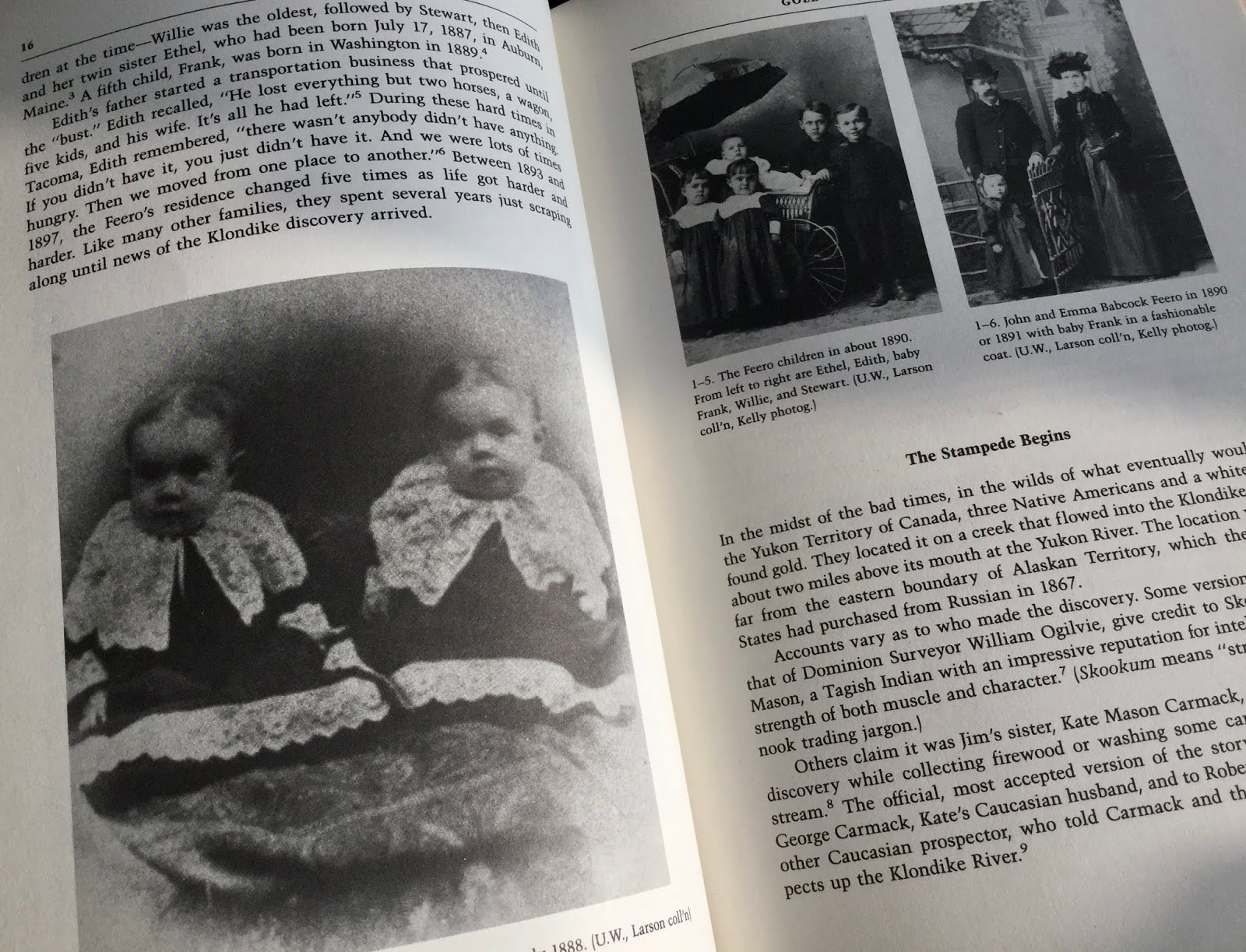
Early this Sunday morning my second youngest boy woke up at 5:50 am and refused to go back to sleep and is now watching YouTube toy videos (don’t judge me!) in my office as to not disturb the rest of the sleeping family. While watching him I had the time to pick up my copy of Klondike Women, a great book by Melanie J. Mayer about the women that also heard the call of the gold rush and made their way to Alaska and the Yukon. It heavily features interviews of my great grandmother Edith Feero Larson. I highly recommend the book.
One of the parts of Klondike Women that talk about the Feeros.
Anyway, I’m rereading the section talking about how the family made their way from Tacoma to Skagway and it talks about the steamers that transported prospective gold rushers north. After her father John made his way north, he soon made enough money to send for the rest of the family. Great grandma Edith, her siblings, and mother made the journey on the steamer Al-Ki. Amazingly, it was relatively easy to find a picture of this steamer. The picture shows it docked at Skagway (probably). The book, through the accounts of Edith and other women, gives you a great idea of how hard the journey was and the life that was waiting for them up north.
Al-Ki docked in Skagway. Photo credit

Monday, March 9, 2020

Visiting the Old Homestead in Skagway Virtually!

We live in an extraordinary age when it comes to what the Internet enables us to do. In exploring my father's family's time in Skagway, I was never able to get the location of his childhood home. It seemed like a reasonable task. Skagway is located in a valley, unable to grow any larger than when he lived there and it's relatively small with a grid-like layout. And thanks to Google Maps street view function, I could actually virtually walk down each street without having to pay for an expensive ticket to this remote town in Alaska. However, his memory was too fuzzy to remember the address of the place he called home until his family moved to Anchorage. The biggest hint that he and his sister could give me was that it was across the street from the now-gone White Pass and Yukon Hospital. So, with that little bit of information, I first went to the Skagway News for information. They couldn't help. Then, on a hunch, I emailed the Skagway Museum and to my surprise, within a few days they emailed me back with the exact location and a detailed description of the house so that I could find it online! (Sidenote: did you know that most residents in Skagway don't have address numbers?! My mind is blown!)

Quickly I opened up the laptop (Why doesn't street view work on iPads, by the way?) and using their information I was quickly able to find the home of my parents, grandparents, and great-grandparents. It was amazing that the house was still there and as my father and aunt described it. It was great to see a house that I probably will never be able to visit in person as it far too remote and too expensive a journey. It was also a lot of fun to print out the screenshots and send them to my father and hear his reaction to them. Unfortunately, I was unable to see the porch from the street view because of the tree. Otherwise, I would have been able to check for the location of the adorable picture (below) of my dad and aunt when they were little. (By the way, if you happen to be in Skagway and figure out where this house is, leave the owner alone. I don't know who this private citizen so respect their privacy.)

My father and aunt on the porch in Skagway (1940s).
My father's childhood home in present-day Skagway (2019?).

Thursday, March 5, 2020

Great-Grandmother Edith Feero Larson in Her Own Words: Part One of an Audio Interview From Over 40 Years Ago


When I started this blog to cover my family history there was one person I especially wanted to write about, my great-grandmother Edith Feero Larson. A natural storyteller, Edith, loved to talk about here days during the Gold Rush in Skagway, Alaska. Because of her place in history and her great memory, I have been able to read a lot about her in books about that period like Klondike Women by Melanie Mayer. Even better, recently my Aunt was able to covert three audiotapes of an interview with great-grandma conducted around 1980 into digital form. With the files on the cloud, I was finally actually able to hear her in her own voice describe her life. It enabled me to get to know a great-grandmother that I had only met once as a baby and even allowed me to introduce her, in a way, to my children, her great-great-grandchildren. Now, over the next few months, I will be uploading parts of this interview in text and audio form. By the way, who exactly conducted the interview is a bit of a mystery right now. It may be a grandson or just someone who was really interested in the history of Skagway and the White Pass and Yukon Railroad. I'd love to meet him and thank him. He's provided me something to treasure for generations to come. Today's clip is a bit short but I think it's a good place to start. I hope you enjoy it. Below the YouTube clip is the transcript of part one. 

Starting in Tacoma
1887, my folks lived in Auburn, Maine. They had two boys, 4 and 2 years old when my twin sister and I was born to raise the family to double the family to two boys and two girls. And they lived in Auburn, Maine and my father was a teamster. He ran the transfer business with his brother. After a while they didn’t get along too good so when grandmother came back from the state of Washington and told about the wonder west, then he decided to sell out to his brother and move west. We were 18 months old then. Grandmother was working in the Kushman school here in Tacoma. And moved west and he went into the transfer business in Tacoma. (He) was doing really well, he had his place of business on J street, just about a block from the Fannie Paddock Hospital which is now the general hospital. 


When the big bust came in the early nineties everybody lost everything. He lost everything but his family you might say. And from there on we went from one place to another because you had to get the cheapest you could do and we moved from one place to another, where we could get rent and get enough to eat. On Thanksgiving day of that year mother had two cookie ornaments sitting on the organ (?) that she had put there because, well, when you got plenty you don’t give a damn. You put dipsy (?). And she had them for ornaments. There was nothing to eat in the house and four children. Well, there was five by then. And she broke them there two cookie ornaments up and give it to us children for something to eat. Dad was downtown in Tacoma hunting for, see if he could get enough money off of that that was owed to him to buy groceries. He got home at 10 o’clock that night. Mother hadn’t had a thing. We had those two cookie ornaments. And he brought home some groceries. Mother got us all up at 10 o’clock at night and cooked us a dinner. I don’t know what I could tell you about them except they were gingerbread men, like you see today. Oh, there were about this high. 
(Well, about a foot then) No, not a foot high. I’d say about 8-9 inches high. And that’s what we had for our dinner. But we had plenty to eat after that.

Thursday, February 6, 2020

All the Way From Sweden: Great-Grandfather Karl Larson


Karl and Edith Larson, 1907 and 1945.
Karl Larson (1882-1962)

It's hard to imagine what my great-grandfather went through before he made it all the way to the small goldrush town on Skagway, Alaska. Karl Larson was born in the small town of Ingatorp, Sweden. From there, at the age of 19, he made his way to New York, arriving on April 1st, 1903. Eventually, he ended up in Skagway, where he met my great-grandmother Edith Feero. They got married and had four children (Velma, Rainy, Stewart, and Ellen). (Not to be forgotten, Edith and Karl also adopted Phillip Olsen when his mother died shortly after giving birth)

In Skagway, Karl made his living as a car inspector for the White Pass and Yukon Railroad. Handy with tools he never turned down a neighborhood kid you needed their bicycle fixed. According to my Aunt (his grand-daughter), Karl was a quiet Swede who loved to tease her by blowing his pipe-smoke into her face. He also taught her how to eat peas with a knife. My father remembered him as a very loving grandpa who was able to build and assemble a crib without using nails. When the children needed shoes he would even make those. He was also protective of his family. He wouldn't let his alcoholic former son-in-law take his grandchildren (my father and aunt) away from his daughter Rainy. I can also thank him for my height. According to my father, he was much taller than Edith (who was around 4'11"), perhaps around 6'2". They must have been quite a pair.