Sunday, December 19, 2021

The 100th Anniversary of Great Grandpa Karl Becoming an American Citizen!

 100 years ago today, on December 19th, 1921, my great grandfather Karl Larson received his citizenship and became a full-fledged American. Karl came from a small town in Sweden and, after landing in New York, eventually found his way to the small Alaskan town of Skagway. It was there where he would eventually marry my great grandmother Edith Feero and make a life for himself while working as a carpenter for the White Pass & Yukon Railroad. Although I’ve shared it before, here is the certificate of his citizenship (below) and my favorite photo of him (above) with my grandfather Tex in 1946 while working on the railroad. 


Friday, May 7, 2021

The Final Two Pieces of Closure

My father, although not a poor man, did not leave behind many material items of value in his death. In my mother’s small apartment lies two large boxes filled with DVDs of MASH, books on Alaska, the many decks of playing cards I brought him from the flights I took to see him, and countless photos of his grandchildren that I sent him. 

Two items that I did value finally made their way to me yesterday. One was the Alaska license plate that he had on his car when he made his way down the Great Alaska Highway all the way to Southern California in the late 60s. The license plate hung on the wall above the tools in the garage in our Arcadia home for as long as I could remember. I made sure to take it down carefully when I was moving everything out of the house when it was put up for sale. For some reason, I always wanted this piece of family history. My dad offered for me to take it back with me when I last visited him from Japan but I declined at the time. I think I said I would get it the next time I saw him. Little did I know there would be no next time. Perhaps it felt too final for me to take it at the time and I declined, as if taking it would confirm my father would die. 

Looking at it now, I realize how beaten up it is, with the blue paint rough from exposure to the elements while it was in service no doubt. Still, for something that is 53 years old, it looks pretty good on the wall in its new home in Tokyo. It's kind of funny to think about the life this license plate has had. It started out on a car in Anchorage in the 60s, eventually went down to California where it rested on a garage wall for decades and now it's made its way all the to Tokyo, Japan. I wonder where it will go in the future when it gets passed down to one of my children.

From the wall in a garage in Arcadia, CA to Tokyo, Japan.

The other item that was sent to me was the last birthday present I gave to my father, a rather uniquely designed wrist watch. Because he always had trouble remembering the time difference when he called me in Japan I found him a watch with two faces showing the two different time zones. It was actually the second watch of this kind that I had gotten him but he cracked the face of the first watch. He loved the watch and it came to me in surprisingly good condition although it needs to have its battery replaced. I hope I can get a new battery soon and start wearing my father's final watch.


Things are finally drawing to a close when it comes to my father. His ashes have finally made their way to my mother, his obituary made it into the LA Times (and the Skagway News!) and these mementos have finally arrived at my doorstep. These two items, of little value to others, will be treasured by me forever. 

Saturday, February 13, 2021

Remembering My Father, Karl De Haven: 1936 - 2021


My dad in Skagway, Alaska.
In front of his home in Arcadia, CA.

This site, dedicated to my family's history, is usually filled with accounts of relatives who passed away long, long ago. Unfortunately, today's entry is dedicated to my father, Karl Michael De Haven, who passed away in his sleep just last Friday on February, 5th, 2021. He was just a couple months short of his 85th birthday. 

Born in 1938 as the second child of Jim Hartley and Urania (Rainie) Larson (daughter of Edith Feero), my dad’s life kind of got off to a rough start actually. Unfortunately for the family, Karl’s birth father Jim turned out to have an alcohol problem and was apparently abusive. The final straw was when, while drunk, he shot a gun off, narrowly missing hitting Urania in the stomach while she was pregnant with my father. Urania then left Jim and soon after (how soon is hard to calculate) married Vernon De Haven. Some time later Jim came back to try and take back his firstborn daughter Joyce but was prevented from doing so. He was allowed to visit the kids once on the condition that he not reveal that he was the children’s father. Although Joyce disputes that Jim didn’t want Karl, my father still mentioned the pain of this perceived rejection toward the end of his life. He also expressed great gratitude that his step-father (who he called “Tex”) had saved the family from a horrible situation. (Interestingly, Tex first dated Urania’s sister Ellen for a time) His grandfather Karl (his namesake) also did well to prevent Jim from taking back the kids. (Actually, because he shared his name with his grandfather, my father was called by his middle name “Mike” inside the immediate family)

My dad with his sister Joyce in Skagway.

After a few years in Skagway, my father and his family moved to Anchorage where Tex worked for Alaska Railroad. By then he had two little brothers (by Tex); Roy and Pat. After getting kicked out of University of Alaska Fairbanks (for, as my dad described it, “being at the wrong party”) he made his way to University of Western Kentucky where he would graduate with a BA. (He also later obtained an MA from USC) To support himself through college he worked at fish canneries in Alaska. Eventually after working as a surveyor (for the military building bases),a forrest ranger, and some other odd jobs he started his career as a teacher. It was as a teacher at Ursa Major Elementary School where he was introduced by his best friend Charlie to his future wife (my mother) Mary Hennessy. The two married in 1967 and then made the long trek down the Great Alaska Highway to her native Southern California (she was originally from Long Beach).

My dad and mom at their wedding (1967).

The couple first settled in Mission Viejo but were unable to find teaching positions close by. Tired of the long commute to Pasadena (where my dad taught) and Arcadia (where my mom taught) they moved to Arcadia, where they remained for good. By then, my brother (who was born while they were living in Mission Viejo) and I (born in Pasadena after the move to Arcadia) were in the picture and our family (plus or minus many cats and one poodle) was complete.

My dad would end up teaching science and math in Madison Middle School in the inner city for many years before moving on to Wilson Middle School (located much closer to Arcadia, just over the border in neighboring Pasadena). He was also extremely active in the MESA program at Cal State LA. The MESA program helps educationally underprivileged kids excellent at math, engineering, and science, helping many become the first in their family to go on to college. In the summers, my dad would also teach oceanography at Baldwin Stocker Elementary in Arcadia. This was where I had the unusual opportunity to be a student in my dad’s class. His influence on his students was great. For many, many years, it seemed that we would run into his former students working somewhere. To them, he was always know as “Mr. D.”

One of my father's school portraits.
As a person, my dad was a very friendly, talkative guy. As my aunt described, to him there were no strangers, only friends he hadn’t yet met. As a child, this habit of him striking up conversations with any and everyone could be sometimes embarrassing (I later heard that his mother was the same way). We often joked in the family, that someday he might accidentally start a conversation with a serial killer with a line like, “That’s a nice knife you’ve got there.” He was good natured and loving, never hesitating to express his feelings for me whenever I called him up from Japan. He also loved to laugh. His favorite tv show of all time was probably MASH. At night, while typing his lesson plans out he would watch the show from 11 to 12, his “holy hour” as he called it. He was a bit clumsy (although he was a very good bowler for many years, winning trophies while in Alaska) and sometimes sloppy with his clothing (mom did her best to keep him looking good). He was also an excellent cook, preparing almost all of our meals at home and only relinquishing the kitchen when grandma Rainie would come to visit. I often remember him falling asleep snoring in front of the tv only to wake up when I would change the channel. "Snore-snort, I was watching that." He was horrible with names, often confusing Hershiser with Kershaw when talking to me about the Dodgers ("Dad, Orel has been retired for like 20 years!"). 

Karl bowling as a youth.

As a father, he made sure to take my brother and I to the kind of events his father never took him to. He took my brother many times to see the Dodgers in Chavez Ravine and helped out with his little league team (I was horrible in sports and lasted only one season in t-ball). He took both of us to the LA Olympics in 1984. My brother lucked out by going to a soccer game. I was taken to the much more difficult to understand archery (can you name one famous archer besides Robin Hood??). Still, it was a great memory. Later in life, as I got into pro-sports, I would end up taking him to many hockey, baseball, soccer, and basketball games. Toward the end however, with his decreased mobility, it just became too hard to take him to a game whenever I visited from Japan, leaving me to go alone unfortunately.

My brother, dad, and I after little league.

Sometimes, my dad wasn’t the best at speaking clearly. One funny memory was when we were in the car as a family and he noted that he once had two dogs named “Peanuts and Popcorn” except every time he said peanuts, it sound like “penis.” Surprised by his choice of a name, I kept on asking him “did you really name your dog penis?” He would say yes and repeat the name while mispronouncing it. The more I asked to confirm, the more my mother would laugh, making him angrier because he didn’t understand what was so funny. I think the misunderstanding got cleared up when I asked him to spell it out. 

Karl with one of his dogs.

Retired life wasn’t too kind to my dad. A myriad of health problems (back, legs, shoulder, heart) limited his mobility, eventually forcing him to live the last six to seven years of his life at a rehab facility.  across from Santa Anita race tract in Arcadia, just a few minutes from his house. I would have loved to have him visit me in Japan. It would have been great to see how he would react to such a foreign place and have the chance to see a baseball game in Japan. I also really wish he could have spent more time with his grandchildren. The distance and cost worked against us there. We were able to bring over Yuzuru, my first born, three times and Fumi, my second, once but because of the pandemic, my dad was robbed of a chance to meet his granddaughter Willow (born last February). Damn that virus. Although it’s nice to think he is watching down on her now I would have loved to capture the expression on his face when he was able to meet her in person. 

Karl and his grandson, Yuzuru.
My dad with his first grandson, Yuzuru.
My dad with Fumito, his second grandson.

He was a great father, husband, and person that I and many people will miss dearly. He is survived by his wife, Mary, his two sons, John (JP) and Shawn (myself), his older sister, Joyce, younger brother, Pat, and his three grandchildren (Yuzuru Alistair (5), Fumito Sebastian (4), and Sumire Willow (11 months)). If you have a story to share about him I’d love it if you share it in the comments section.

Monday, July 27, 2020

The Feero That Almost Shot Tom Selleck

I bet that headline got your attention. Yesterday night, I had a moment to myself and decided to take a glance at the book about Christian Feero and all his descendants. Randomly, I opened it up to page 144 to see a picture of Clyde and Mida Feero with a description of their children and grandchildren below. I was surprised to find out that their son Robert and his wife lived in Los Altos, California (relatively close to my hometown). Reading further, I noticed that their son Robert Clyde Jr. was listed as a television and film actor in Hollywood. Wondering if he had been in anything that I would know, I broke out IMDB (Internet Movie Database) and put in his name, and sure enough, there he was
The head-shot of Robert Feero.
I was happy to discover that, while not a star, Robert (who passed away in 2011) had guest-starred in many of the major TV shows of my youth. After making his acting debut in George Lucas' first film, "THX 1138", Robert racked up guest spots on Battlestar Gallactica (the 70s version), the Incredible Hulk, Bionic Woman, B.J. and the Bear, Simon & Simon, Knight Rider, and Magnum P.I. to name a few. Although I wasn't able to find any YouTube clips of his acting I was able to go back and see the episode of Magnum P.I. (I own all seasons on iTunes) in which he guest-starred, playing "Dolphie," a henchman to a drug lord named. And if you look at the shots I was able to take (below) of his first scene you'll understand the headline of this blog entry. (The episode is "...By Its Cover" from 1983, by the way)
Hello, cousin Robert. What's with the gun?
Don't shoot Magnum!
Doing some further research into Robert's career while looking for some more pictures of him acting I came across some photos of him playing a character named Bora, an alien that made two appearances on Battlestar Galactica. There is a great in-depth interview with Robert regarding his time on the show and acting career on a Battlestar Galactica fansite. It's really worth taking a look at. You can also see him briefly in the YouTube clip of the preview of the episode (so cheesy!).
That's my 4th cousin in the center. No resemblance, thankfully.


Finally, before I go too deep into this rabbit hole (too late, I know), I just thought I would share this image below (sorry it's not better quality). That's right! Cousin Robert had his own action figure! How cool is that?!


I hope you enjoyed this little bit of family history. This blog entry was a nice, light-hearted one compared to the previous entries on the death of my great-great-grandfather, John E. Feero. It just goes to show that you never know what you are going to find on the family tree. Sometimes, you might even find an alien. 

Thursday, July 23, 2020

Perished in the Klondike: An Account of John E. Feero's Death From a Local Maine Paper in 1898

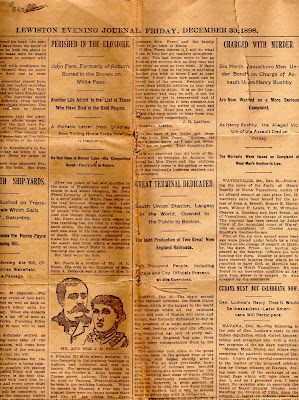
In my last blog entry, you were able to hear my great-grandmother's account of how her father, John E. Feero, lost his life on the White Pass near Skagway in 1898. Thanks to my cousin in Calgary, Jo-Ann Larson, I was able to recently also get a look at an article that recounted his death in a local Maine newspaper, the Lewiston Evening Journal (John and his wife were raised in the area before heading west and then north). She was able to send me an image of part of the page that featured the article from 1898. Amazingly, I was able to find the entire article in an online archive (click here for it!). To make things easier to read, I have retyped the full article below. It's very interesting and as you'll notice, the person who wrote the headlines and caption misspelled Feero with one "e" while the article writer made no such mistake. The article and the letter featured in the article really brings home the tragedy that the family felt for this loss. 


Portrait of John Feero and his wife with his name misspelled.
The original article in the Lewiston Evening Journal.

From the Lewiston Evening Journal, Friday, December 30th, 1898

Perished in the Klondike

John Fero (sic), Formerly of Auburn, Buried in the Snows on White Pass
--
Another Life Added to the List of Those Who Have Died in the Gold Region
--
A Pathetic Letter from Skaguay Post Telling Home Folks How it Happened
--
He Had Been to Bennet Lake - His Companions Save - Fero’s (sic) Life in Auburn
———-
After ten years of toll and sacrifice in the state of Washington and the gold mines in and about Skaguay, Mr. John Feero, formerly of Auburn, has perished in a snow storm at White Pass while on the trail between Skaguay and Lake Bennett, adding another to a long list of people who have lost their lives in that rich though rough country.
Mr. Feero and the man with whom he was traveling with lost the trail in a blinding snow storm. he fell through exhaustion and was soon in his last sleep-the sleep of death. His companion managed to make his way to a camp where he gave the alarm and from which a searching party at once went forth in the hope of rescuing the poor man alive.
But they were too late.
Mr. Feero is a brother of Mr. H. E. Feero. His wife is the daughter of Julia A. Babcock and a sister of Mrs. S. S. Perkins, 317 Main street, Auburn. He was formerly in the trucking business in Auburn and Lewiston and was well known. For several years he lived in one of the George A. Allen houses on Turner street, Auburn. Ten years ago he went to Tacoma, Washington, where he was in the trucking business. When he moved to Skaguay a year ago last August there were no frame house there and like all the other Mr. Feero and his family lived in tents and log cabins. At Skaguay his business has been that of carrying supplies between there and Lake Bennet, on the backs of horses. At times he has had 60 horses in the work and many men. He has done a prosperous business and has invested considerable money in Skagway read (sic) estate and in mining property farther up the line. The distance from Skaguay to Lake Bennett via the White Pass is 40 miles. A railroad is building between Skaguay and Lake Bennett but has only been completed as far as White Pass. Mr. Feero’s wife, Emma G. Feero has shared her husband’s trials and has been deeply interested in all of his ventures. That she is a brave woman goes without saying. She is the mother of four children: Willie, aged 15; Frank, aged 9, and twin girls, Edith and Ethel, aged 11. 
The sad news of Mr. Feero’s death came to Mrs. Babcock, Dec. 29, in a letter from Mr. J. D. Laidlaw of Tacoma, Washington, a friend of the family, who has been in Skaguay for awhile. His letter is as follows:
Skaguay, Alaska, Dec. 12, 1898-
Mrs. Julia Babcock, Auburn, Maine.
Dear Friend: I often promised and intended to write to you but my unsettled condition and restlessness prevented me, but at this time I could not refuse Mrs. Feero’s request or delay a single boat. Poor woman, she has received a terrible blow and may God help her to bear up for her children’s sake.
John went over to Bennett on some business and in coming back he lost his life on the summit of White Pass. They took dinner at Little Meadows on Tuesday, Dec. 6 and stated home. It was storming hard, wing and snow from the south. Not severely cold temperature, about freezing, but they were facing the storm and it was very hard traveling. Near the foot of the Summit they met a park train and were advised to turn back, but being anxious to get home and he and his companion, Mr. Aimery, having crossed so many times, thought they could make it and pushed on. They had one horse which they rode in turn. The snow drifts so fast there that the trail was soon covered and there are no land marks, so they lost their bearings. The horse lost the trail too and in looking around to find the trail they lost the horse. Mr. Feero was complaining of terrible pains and finally gave out. Mr. Aimery carried him on his back for a while, then darkness overtook them and they beat down a  place in the snow and tried to keep moving until day light. Then they started again. At 2 o’clock on Wednesday the 7th of December, Mr. Aimery managed to get into camp 11 of the railroad, about two miles from the trail. he was almost exhausted and out of his mind but he told the men in camp that he had left a man a short distance behind completely exhausted. A relief party immediately set out, but it was too late. Poor John was lying peacefully asleep in the snow. The sleep that knows no awakening in this world. McDonald, a packer who worked for John all summer and myself set out for the summit at once and with the assistance of six railroad men, brought the remains to White Pass and from there they were brought by train.. the funeral was held yesterday, Sunday, from Union church. Mr. Sinclair, the Presbyterian minister conducted the services. There was quite a large turnout and everything was done that willing hands and warm hearts could do, but there is so little that we can do. If we could only take a part of the sorrow and loneliness from those who are left and bear it for them.
As soon as the affairs can be straightened out, probably by the middle of January, Mrs. Feeo and the family want to go back to Maine.
If Mrs. Feero desire it, I will do what I can to help her get matters straightened out. You had better write to her as soon as you receive this, as they may not get away as soon as they wish. if there is anything I can do for you or anything further you wish to know I am at your service. I don’t know how much can be saved out of the wreck. Probably not more than $1000. In addition to that they have a claim in Attin.It is on the London market and may be sold, if not we will have to get it represented and if worth while develop it next summer. Am very sorry to be the writer of such sad news to you. Hope you are well and would like very much to hear from you. I remain yours respectfully,
J.D. Laidlaw
Skaguway, Alaska.
____
On the back of the letter are these words from Mrs. Feero: “Mother, let John’s folks know as I can not write. Oh, I am so lonely. Your daughter, Emma.”
It is not expected that the body of Mr. Feero will be brought to Auburn for burial but Mrs. Feero and the children will probably come in the spring or sooner if her husband’s business matters can be arranged.

Wednesday, July 22, 2020

Edith Feero Larson: In Her Own Words | Part Three: Beginnings and Endings in Skagway

Part three of the interview with great-grandma Edith Feero Larson is a bit long but I wanted to include it all together because it begins her and her family first coming to Skagway and ends with a tragic turn of events that you'll want to stick around for. Enjoy this amazing account of family (and American) history.


Welcome to Skagway
Another little incident that I don’t want to forget is when we went to the first hotel we stopped at in Skagway. Well, mother landed in Skagway with 25 cents in her pocket and four kids. Nobody knew where your next dime was coming from and nobody really cared. So the captain says to the lady, “I’ll go with you to the steamboat office and we’ll see if we can find Mr. Feero.” So we went up to the steamboat office and he went in and wanted to know if anybody there -- the steamboat office was just a tent -- if anybody there knew where Mr. Feero was and a man on the street yells in, he says, “Who do ya mean? Sandy?” Mother got mad. She says, “Is THAT what they call him up here?!” Well, he said, “You know we Tacoma people.” He was Si Tanner, he was later the marshall in Skagway. His son had gone to school with us when we lived on K Street in Tacoma and he said, “I know Mr. Feero. I’ll take the family up to my cabin and I’ll take the boy, leave them there and I’ll take the boy up to where he keeps his horses and see if he’s in town or on the trail.” So he took us up to his cabin, there was little log - little board shack. There was a bed in one corner, a stove in one corner, a little table in one corner, and a box on the other -- to sit on but we could sit on the bed. And he took Bill up to see if he could find dad at home. Well, he was up there and he didn’t know that mother was coming on that boat. Mother had written, “I’ll be on the City of Seattle or the next boat following.” He thought she meant this City of Seattle or the next City of Seattle. She didn’t. She meant the next boat and that’s the one she got on. And he wasn’t looking for us. He was down at the beach the night before when we went -- when the boat pulled past Skagway and went into Dyea. We went to Dyea all night. And when -- they didn’t land nobody there, he didn’t think there was anybody for Skagway. But he came back down to the place and he took mother and first thing she said was, “Hmph! You cut that teddy bear off!”, his old whiskers.


Our First Home in Skagway
So live in a tent we did. We pitched a tent in what was later the middle of main street. And one corner was a stove, a little cast iron stove with a drum oven in the up top. One corner was a bed put up on high posts so they could have storage under the bed. Two other springs was put up on old kerosine boxes or anything you could find to them up on to. And that was -- we had one bed for mother and dad, one for us two girls, and one for the two boys. That would give us six chances to sleep. And there was no table. So dad went out to get some lumber to build, to fix a table and he couldn’t find none. So the only thing he could find was a packing box, which he could rent but he couldn’t buy. Lumber was that scarce. So they drove posts in the ground and put the packing box upside down on the posts and that was our first table. Got the table, no chairs. So they went out in the woods and they cut off blocks of wood the height of what chairs should be. That was our chairs. That was the furnishing for our first home in Skagway. 
Of course, then, he was a man who didn’t take a lot of receipts. “I trust you. I paid you and you’ll pay me. We don’t need receipts.” Paper was worth nothing. But when he was gone, his knowledge was gone too. And they just robbed mother of everything that there was. They robbed her of her horses and everything and they would have taken the cabin if they could have, that we were living in. So she just had to stay there and raise her family there. We got married and raised our family there. So Skagway to me, means more than it does to a lot of people. It’s a start of a wonderful experience and the end of a happy home.


A Rough Night in the “Hotel”
So he had us go over to the hotel to have dinner. So we went over to this here -- looked like a barn, just boards up and down and cleats on the cracks. And we went in there and it’s a long table on one side of the room and there’s an L(?) on the other side, a little lean-to thing. That was the kitchen. On the other side of this barn-place was a long bench and nails on the wall. That was your clothes hangers. And a ladder leading to the raft. So she looked around and she didn’t see nothing. We went up to see where the horses were and see if she wanted to stay up there or downtown where he had two lots. And she came back down -- we started on a wagon but the ruts were so bumpy and bad that we got off and walked. And we got back down to the hotel and she still looked around and she couldn’t see no place to sleep. It was supposed to be a hotel. So she says to dad, she says, “I don’t see any place to sleep.” “Oh, you will.”, he said. And so she kept looking around and she said, “I still don’t find any place to sleep.” “Well,” he said, “You see that ladder over there?” Now mother was born in the state of Maine where everything was just proper. Ladies didn’t show their ankles. Ladies were ladies in other words. She said, “I can’t climb up there! All these men around here!” Well, she found out she either climb up there or she didn’t sleep. So she got up. It wasn't so bad going up because the skirts would hang down. (She) got up on top and the rooms were curtained across with just canvas curtains. And the beds were mattresses laid on the floor. You furnished your own bedding. Well, on the other side -- mother had never been around drunks in her life -- on the other side of these canvas curtains there was drunks all around. We kids had a ball. It was a lot of fun. But mother didn’t sleep. So she gets up in the morning and she looks down this hole and she says, “I can’t go down there! The men are down there!” Well, when you stay up there you don’t get nothing to eat. You gotta get down there to get something to eat so she eventually came downstairs, down the ladder. When she got down on the floor she says, “That’s the last time I’ll go up there! I’ll live in a tent!”


Then he got a man to -- he gave the man the lot he had downtown to put a cabin on the lot up where he had the horses. They got the cabin built and they put in some itty bitty windows and a little bitty door. Mother was short and she couldn’t even stand up straight and walk through the door. And she couldn’t get half daylight enough. They just had two of these little peek hole windows and she says, “I won’t have those windows and I won’t have that door! That door’s got to be bigger.” “I can’t get no more lumber. (There) ain’t no more windows in town. I’ll tie-- I’ll nail a rag over them.” So they finally found more windows and they found enough lumber to make another door. And they put legs on this first door. They put legs on it and it was a table for our cabin. When they got the done they only had lumber enough to board over the top halfway so they put the boys’ beds up there and that it worked out alright until Frank fell off of the top story down into the wood box! And two bunks on the end of the cabin, when he fell off into the wood box they went out in the woods again and got some poles and made a railing.  (26:39) And one corner of the cabin was the sitting room. The sewing machine and the organ was put down in this corner. The other corner up here was the kitchen. It was a wood box and a stove. On the other side of the room was this table, the door table and two hooks up on the rafters where they swung an old-fashioned net hammock. That was our couch. And we had a little bit of a rug put underneath of that. And the other corner was the two bunks. That was the size of our cabin and it was furnished. That was our furniture. You didn’t have furniture in those days, you know. But everybody else was living the same way and who cared? Everybody was happy. You know, if you didn’t have cars and you didn’t have this and you didn’t have that and everybody else didn’t have it, you wouldn’t mind. It was the same way up there. People would go out and dig holes in the riverbed or something. They were prospecting. Well, there was never any gold in Skagway but they prospected anyhow. So we moved into that cabin the day before Thanksgiving in 1897. 


Packing for Ezra Meeker
That was our home until dad was on the trail...Dad packed in his outfit something I don’t want to forget. Dad packed when he was packing his outfit, dad packed Ezra Meekers first consignment of freight over the White Pass trail. And that was a consignment of chickens. And when they packed those animals, they packed the sides of a horse and put a crate of chickens on the top, see. And all them heads sticking out. Well, then Ezra Meeker went back and when he was in Dawson with this outfit he arranged for a cabin with a raised floor so air would go all around and he went back out and brought in a load of potatoes. He took them and dad packed that outfit over. At that time he had one of his one, I think it was his daughter and her child, and they lived in -- do you remember where Betty Summer lived when you was up there? (29:50) 


(Tape problem)


Expensive Chickens


Well, we should be in business again. I got it working. 


You got it working again? Then they took these chickens in Dawson. This prospector came through years later and he told me he had come out of the mines in the summer of ‘98 and he saw this dilapidated looking chicken in the crate on the outside of the store and he says, “It was marked 75” and he thought it meant 75 cents so he went in to buy the chicken. Then he found out that the chicken meant, the 75 meant dollars per pound! He didn’t buy the chicken. 
And what else did we miss?


The End of a Happy Family
The part about where your dad had to go back and collect for the potatoes. 


Well, he went out and got the potatoes. Dad had -- when we went and got the potatoes as far as Bennet he forgot to pay for the potatoes, the freight on them, and he went and loaded them on a scal (?) and went for Dawson. Dad had to make the trip for Dawson. He went to Dawson and came back, he didn’t get all the money he was supposed to get for the potatoes. But he came back out on the last boat leaving Dawson and he got as far as Lebarge and the boat froze in. So they came the rest of the way -- it was a Peterborough canoe. He and two other men came up the river. They got into Whitehorse -- into Lake Bennett and came home and he said he had to make one more trip over to Bennett before he would take little Nellie, his lead horse from the Winter before, out and pasture her for life. And then he would have his hernia operated on and come back to Skagway and in the spring we would all go on into Dawson, it was such a beautiful trip. But this last trip was in late November and he was coming back to Skagway. They tried to get him to keep off of the summit that night because it was a storm on the summit. He said, “My wife and family was on the other side and I’m going home.” 


He got into the storm and he got sick. They stayed all night, he and a Mr. Amery, and they walked back and forth in about a ten-foot trail, back and forth to keep it open so they wouldn’t freeze to death. In the morning they could see that it cleared and they could see the smoke from the hospital tent on the railroad. And the man said, “John, don’t stop. I’ll go for help.” And he left dad and he went for help but he was so far gone himself that he made a zig-zag trail. He didn’t go straight. Well, they didn’t dare follow straight through on the trail. They had to follow his footsteps to find the man that he said was back there. When they got there dad had just passed away. He was still warm. That was on the seventh day of December of 1898 when dad passed away and left mother with four children. 

Tuesday, July 14, 2020

Edith Feero Larson: In Her Own Words | Part Two: And Then the Gold Rush Started...

Today, I have something special to share with the blog. As I said in an earlier blog entry, last year I was lucky enough to receive several audio files (taken from cassette) of an interview with my great-grandmother Edith Feero Larson. The interview was conducted sometime around 1980 by a man interested in Gold Rush-era Skagway. Over the last few months, I have transcribed the interview and now I can share part two of the interview (you can see part one here). I've put it on video because I just think it's amazing to hear her tell about her experiences in her own voice. Below is a transcript of today's video. I hope you enjoy it.


And Then the Gold Rush Started…
And then the gold rush started. We were living in Larchmont. The gold rush started and he wanted to go but he had no money. So two men of Tacoma, who had done business with him when he was in the transfer business, volunteered to help him get to Alaska. Alaska was a pretty cheap - you could get up there pretty cheap. You could ship a horse for five dollars. And he had two horses left at that time. One was so darn mean that nobody would have it. He couldn’t give it away and he couldn’t sell it. So he decided to take it with him. The other horse was a good gentle horse and he could leave that horse down here which he never did claim him again. And this horse he carried up, he left on this little steamer Edith, just crowded. He had this horse on it and he got into Skagway. They went through the rough places on the trip. They could see all kind of dead horses around floating on the water which was killed by the rock of the ship and the falling down and the others trampling them cause they was crowded in as all. Unloaded this horse on the beach, which they had to do. They had to load them into the water and swim them to shore. And when he got it on the beach a man stepped up and he said, “Mister, I’ll give you $175 for that horse. I’ll hire you. If you can handle that horse, you can handle mine. I’ll give you $5 a day and your keep”, which was a goldmine to a man who had been working for 50 cents a day and feeding his own horses. So he went to work for this man, which was the first man to bring pack horses into Skagway. And he worked for him for a while. Turn that thing off. I’ve got to drink my coffee.

Shipping Over the White Pass
They were driving pigs over the White Pass trail. The rest of the wagon trail was built. It was a trail of 97 and they moved down on to the river in the winter of 98. In the spring of 97 they moved up onto the wagon road. In the fall of 97, they moved on up to the railroad. So you see how fast the country grew. The surveyors landed in Skagway in March of 98. In August of 98, the train was running as far as White Pass city, that’s the first 13 miles out of town. And the White Pass railroad is the only railroad, so I have been told, that ever paid for itself, mile for mile, as it was built. See, people, if you could haul your freight from here, two miles, you didn’t have to pack it. So even for two miles, they’d haul, they’d pay the freight on that horse. It cost them from 50 cents, anywhere from 50 cents to a dollar, maybe more if you hired a pack train because if I have a load and you have a load, they take my load for 75 cents maybe, and you come along and you say, “Well, I want to get over. I’ll pay you a dollar a pound.” Well, you leave my load and then take your load. Somebody else may walk up and say, “I’ll pay you a dollar and a quarter for a pound.” Well, your load is left. That’s the way packers packed their freight. Dad had one price and he charged it and he didn’t take somebody else in the place of them. Most of them would leave your load because it was more money for them. But when the train came along they could get that first pound that first mile, they’d take it. They’d get the second mile, they’d take that to pay the freight. It made the packing much cheaper. 

The Horse that Got Away
And in August they were running the trains as far as White Pass city. My oldest brother got sick in White Pass city in August and mother brought him down on the train to Skagway. (She) left us kids up in the old hotel to go down on the pack train. So when we were coming down, them packers thought they’d keep track of us kids but not letting us have a halter or a bridle on the horses. So they took them all off. They didn’t know that us kids had been taking the horses to water and that and there and wherever we wanted them to go so we could drive anyhow. We got around the corner at Rocket Point and a little old engine came round at said, “Toot! Toot!” so the horse my brother was on was gone. And they never stopped that horse until he got clear into town. We kids went after him and them packers never dared tell mother what- that they had taken the bridle and halter off them horses. They never dared tell them. If father had known it they wouldn’t have had no job. That’s the way life goes, you know. We kids were smart. But we had more fun than the kids today. 

The Dead Pig
But this pig that I was going to tell you about, when they were driving the pigs over, we lived over in that little old hotel. And they lost a lot of their pigs on that first 13 miles. Pigs can’t stand that rough ground. So that big-hearted guy says to my little brother, he says, “Hey sonny, I’ll give you a pig if you take care of it.” So he gives Frank a pig and he says, “You gotta take care of it and keep it warm and it’ll be alright.” Frank then crawls way in under the bunkhouse and we fixed a nice bed for the pig and put it to bed and fed it. And the next morning, the pig was dead. The pig was already half dead when he gave it to him. So we didn’t have pig. He had dead pig. 

The Lynch Party
And it was in White Pass city, when we lived there that they were going to lynch the doctor. He hadn’t been at the, what they call the camp in the clouds. At that time it was way up on top of the hill. It was really in the clouds. And there was a lot of men up there who were sick and he hadn’t been up there. Well, the main hospital, at that time, was in White Pass City, at the foot of the hill. And we kids saw these men going down with their axes, their saws and guns and their lanterns and everything else. We thought, “That’s a lot of fun.” They were going to do something and we were going to go see. And mother came out of the door just as we kids were coming down the trail. She stopped all the fun. But they turned over that night, they turned over the beds, they turned over everything in that hospital, trying to find the doctor. One man got smart and he rode horseback as fast as he could down into town and told the doctor what was going on. The doctor was down having a good time in town. Before daylight, the doctor was in the camp in the clouds. Now you’ll see what lynch parties will do.

The Singing Man
Another thing that struck me in those days was when we were standing on the bridge going over towards to the wagon road from the hotel. He heard a man singing. And it sounded so nice. You couldn’t see anybody yet. Pretty soon, round the corner comes a man sitting sideways on a horse. He wasn’t stradling in the horse. He was sitting sideways. And he was singing “There’ll be a hot time in my home when I get there.” He was happy. And that has always stuck in my mind, the happiness that was in that voice coming around the mountain. That is something that you don’t always find.