Friday, May 22, 2020

The Story of Benny Benson and Our Fantastic Souvenier

A couple years ago, while I was packing up everything and getting ready to sell the family home, I was flipping through some photo albums put together by my mother when she first made her way to Alaska. My mother is a native of southern California and in the sixties she moved to Anchorage to teach, eventually meeting and marrying my father while she was there. She always kept such detailed and artistic albums so it was a joy to go through them, reading all the details that she wrote so neatly next to photos and other objects (her handwriting hasn't changed!). It was in one of these albums that I came across one of the coolest Alaska souvenirs around, a small Alaska state flag autographed by the designer of the flag, Benny Benson. When I saw it on the page, I made sure to take a quick picture of it before I moved on. Now, I had heard about this memento through the years from my mother but this was the first time I actually saw it. 


The Alaska state flag signed by Benny Benson, the boy who had designed it.
The story of Benny Benson was an interesting one. Born in 1913 to a Swedish-American father and a Alutiiq-Russian mother, Benny and his brother were placed in an orphanage at the age of 3 when his mother died and his father could not care for him. It was at that orphanage in 1927 in Unalaska that Benny entered a state-wide contest to design a flag for the (then) territory of Alaska. As a prize for winning the contest, Benny was given $1000, a gold watch, and a trip to Washington D.C. 

So how did we get our hands on an autographed Alaska state flag? Well, according to my mother (and her detailed photo album), "He is the only living person who has designed a state flag. We had the privilege of meeting Benny in Anchorage and having diner with him. Benny signed thousands of these little flags the Saturday that we saw him. The money from the sale of the flags went toward a college scholarship for Miss Alaska." Benny, unfortunately, passed away a year or two after my mother met him at the young age of 58 in 1972.


While searching for more on this story I was able to find an interview that Benny did for the Anchorage school district in 1971. Some of the footage is of poor quality but it's still an interesting listen. Skip ahead to the 3:10 mark to hear all about entering and winning the flag contest. It's a wonderful story and amazing that my mother was able to get this flag signed and I hope it remains a treasure in our family for generations to come. (I just wish that the tape used to put the flag in the book hadn't discolored the flag a bit.)

After I finished writing this entry I also came across a cute animated recap of Benny Benson's story in the show Molly of Denali. I hope my kids will enjoy this.


Update: After posting this I checked again with my mother of her experience. According to her, she and my father saw Benny Benson at a parade in Anchorage (he was the grand marshal). The two rushed to try and get him to sign their flag after the parade but weren't able to catch him. Having given up on getting the flag signed they went to dinner only to spot Benny at the restaurant. My mother recalls telling my father, "Isn't that Benny Benson?" to which he replied, "He doesn't look anything like that." Of course, it was him and they were able to get his signature. 


Thursday, May 21, 2020

Visiting the Homestead Part 2

Just a short entry today as I'm very busy with work. I was looking through some old photos today for the first time in a while and with the added knowledge of being able to recently visit my father's old childhood home in Skagway (see this earlier blog entry) I was able to see them with new eyes. Now, armed with that knowledge, I realized that these two photos of my father were taken in front of that house. In the second picture, you can see what I believe was the White Pass and Yukon Hospital as well as a little tree to his left. Looking at the house now, you can see how much that tree has grown!


The homestead today, some 75 years later!

Monday, April 27, 2020

Attu: Remembering Alaska at War

Recently, a distant family member was kind enough to share some photos from an old family album passed down through the years. Understandably, some were shots of family members long gone. Surprisingly, there were also some photos that were either taken by a late-relative or passed on to him that showed shocking scenes of the aftermath of the battle of Attu. 

Nowadays, most people have forgotten (or never knew) but during World War II the Japanese military invaded the islands of Kiska and Attu, found on the very far tip of the Aleutian chain. These were the only times that the Japanese military set foot on the mainland United States. On June 7th of 1942, the Japanese landed and took over Attu unopposed. They had also invaded the nearby island Kiska one day earlier. Almost a year later on May 11th, the US military made an amphibious landing and after a brutal battle, retook the island. The battle lasted 19 days and the cost of lives, especially for the Japanese forces, was high. Of the US force of 15,000, 549 were killed. The smaller Japanese force of 2,900 lost 2,872. Only 28 prisoners were taken. 

Among the brutal pictures that were passed on to me, there were a handful of pictures that were taken off the bodies of the soldiers after the battle. They were probably taken during the period that the Japanese occupied the island (for months they basically had nothing to do). They are surprisingly playful in nature. I'm not sure if these photos (or copies of them) made it back to their families back in Japan but I hope they did. Although I'm not sure where to start, since I'm in Japan currently, I may try and see if there is a way to forward these images to relatives of the soldiers. I've chosen not to share any of the gruesome photos here because I don't believe it would right.  

Japanese Skier in Attu


While researching this topic, I also came across an excellent program on the battle from an Alaska station. In the report, they talk about a book that was written by one of the natives who survived the invasion (he was six at the time). The program is really well done and worth a look. I'm also happy to see that the book, "Attu Boy", is available in PDF form online for free. Below is the program from KTVA. 


It's funny how things end up. Relatives of mine fought the Japanese in World War II and now here I am, living in Japan and raising my Japanese/American children here.

Saturday, April 4, 2020

Reading Klondike Women on a Lazy Sunday Morning

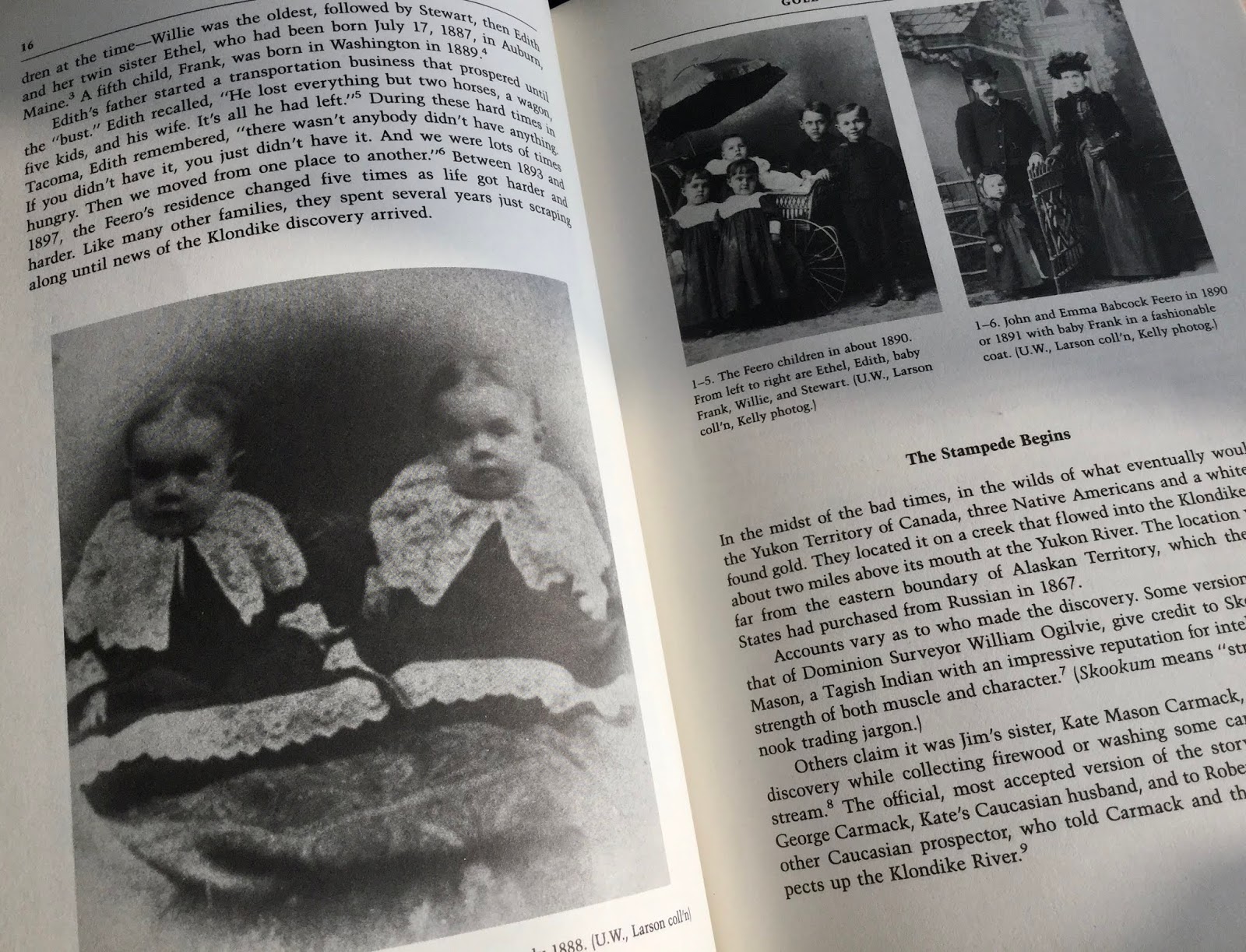
Early this Sunday morning my second youngest boy woke up at 5:50 am and refused to go back to sleep and is now watching YouTube toy videos (don’t judge me!) in my office as to not disturb the rest of the sleeping family. While watching him I had the time to pick up my copy of Klondike Women, a great book by Melanie J. Mayer about the women that also heard the call of the gold rush and made their way to Alaska and the Yukon. It heavily features interviews of my great grandmother Edith Feero Larson. I highly recommend the book.
One of the parts of Klondike Women that talk about the Feeros.
Anyway, I’m rereading the section talking about how the family made their way from Tacoma to Skagway and it talks about the steamers that transported prospective gold rushers north. After her father John made his way north, he soon made enough money to send for the rest of the family. Great grandma Edith, her siblings, and mother made the journey on the steamer Al-Ki. Amazingly, it was relatively easy to find a picture of this steamer. The picture shows it docked at Skagway (probably). The book, through the accounts of Edith and other women, gives you a great idea of how hard the journey was and the life that was waiting for them up north.
Al-Ki docked in Skagway. Photo credit

Wednesday, March 25, 2020

In a Time of Crisis: A Look at the 1964 Alaska Earthquake

4th Avenue in Anchorage after the 1964 earthquake.

As the father of three small children, I got one of the rarest gifts in the form of some quiet time alone (while walking to the train station to go to work). During this respite, I was able to catch a rebroadcast of one of my favorite podcasts, 99% Invisible, covering the Great Alaska Earthquake of 1964. Specifically, the podcast covered the story of Genie Chance, a reporter for a local radio station at the time. It's a great episode and you should really take the time to listen (and give the show a chance if you haven't already). Just as a refresher, the earthquake was a doozy, to say the least. Measuring an astounding 9.2 on the Richter scale, the earthquake hit the Anchorage area at 5:36 pm on March 27th, 1964.  The earthquake itself killed 9 people and the tsunamis it caused all over the world killed another 122. Perhaps most unbelievably was the length of the quake at 4 to 5 minutes.

With a family with deep roots in Alaska, I have always been aware of this great disaster with some stories about the event pasted on through my mother (who later moved to Alaska) regarding friends who came home only to find their home "slid into the sea." By 1964, my grandmother and grandfather had moved from Skagway to Anchorage, thankfully surviving the quake unscathed (as far as I know). One time during elementary school, when my grandmother was making one of her visits to our California home (after retiring from the railroad, grandpa and grandma moved down to the lower 48 and periodically stayed with their children in California and Texas) I asked her about this catastrophe. Our exchange went something like this:

"Grandma, what did you do during the Great Earthquake of 1964?"

"Well, I sat on the sofa and waited for it to be over!"

Grandma didn't quite have the gift of storytelling that her mother did. As long as I knew her, she was very matter-of-fact and blunt. Well anyway, the episode of the podcast is great (link) and the book about Genie Chance and the Great Earthquake looks equally interesting. Maybe in these troubling and uncertain times, a recount about how people came together in the face of a disaster might be just what the doctor ordered.

Monday, March 9, 2020

Visiting the Old Homestead in Skagway Virtually!

We live in an extraordinary age when it comes to what the Internet enables us to do. In exploring my father's family's time in Skagway, I was never able to get the location of his childhood home. It seemed like a reasonable task. Skagway is located in a valley, unable to grow any larger than when he lived there and it's relatively small with a grid-like layout. And thanks to Google Maps street view function, I could actually virtually walk down each street without having to pay for an expensive ticket to this remote town in Alaska. However, his memory was too fuzzy to remember the address of the place he called home until his family moved to Anchorage. The biggest hint that he and his sister could give me was that it was across the street from the now-gone White Pass and Yukon Hospital. So, with that little bit of information, I first went to the Skagway News for information. They couldn't help. Then, on a hunch, I emailed the Skagway Museum and to my surprise, within a few days they emailed me back with the exact location and a detailed description of the house so that I could find it online! (Sidenote: did you know that most residents in Skagway don't have address numbers?! My mind is blown!)

Quickly I opened up the laptop (Why doesn't street view work on iPads, by the way?) and using their information I was quickly able to find the home of my parents, grandparents, and great-grandparents. It was amazing that the house was still there and as my father and aunt described it. It was great to see a house that I probably will never be able to visit in person as it far too remote and too expensive a journey. It was also a lot of fun to print out the screenshots and send them to my father and hear his reaction to them. Unfortunately, I was unable to see the porch from the street view because of the tree. Otherwise, I would have been able to check for the location of the adorable picture (below) of my dad and aunt when they were little. (By the way, if you happen to be in Skagway and figure out where this house is, leave the owner alone. I don't know who this private citizen so respect their privacy.)

My father and aunt on the porch in Skagway (1940s).
My father's childhood home in present-day Skagway (2019?).

Thursday, March 5, 2020

Great-Grandmother Edith Feero Larson in Her Own Words: Part One of an Audio Interview From Over 40 Years Ago


When I started this blog to cover my family history there was one person I especially wanted to write about, my great-grandmother Edith Feero Larson. A natural storyteller, Edith, loved to talk about here days during the Gold Rush in Skagway, Alaska. Because of her place in history and her great memory, I have been able to read a lot about her in books about that period like Klondike Women by Melanie Mayer. Even better, recently my Aunt was able to covert three audiotapes of an interview with great-grandma conducted around 1980 into digital form. With the files on the cloud, I was finally actually able to hear her in her own voice describe her life. It enabled me to get to know a great-grandmother that I had only met once as a baby and even allowed me to introduce her, in a way, to my children, her great-great-grandchildren. Now, over the next few months, I will be uploading parts of this interview in text and audio form. By the way, who exactly conducted the interview is a bit of a mystery right now. It may be a grandson or just someone who was really interested in the history of Skagway and the White Pass and Yukon Railroad. I'd love to meet him and thank him. He's provided me something to treasure for generations to come. Today's clip is a bit short but I think it's a good place to start. I hope you enjoy it. Below the YouTube clip is the transcript of part one. 

Starting in Tacoma
1887, my folks lived in Auburn, Maine. They had two boys, 4 and 2 years old when my twin sister and I was born to raise the family to double the family to two boys and two girls. And they lived in Auburn, Maine and my father was a teamster. He ran the transfer business with his brother. After a while they didn’t get along too good so when grandmother came back from the state of Washington and told about the wonder west, then he decided to sell out to his brother and move west. We were 18 months old then. Grandmother was working in the Kushman school here in Tacoma. And moved west and he went into the transfer business in Tacoma. (He) was doing really well, he had his place of business on J street, just about a block from the Fannie Paddock Hospital which is now the general hospital. 


When the big bust came in the early nineties everybody lost everything. He lost everything but his family you might say. And from there on we went from one place to another because you had to get the cheapest you could do and we moved from one place to another, where we could get rent and get enough to eat. On Thanksgiving day of that year mother had two cookie ornaments sitting on the organ (?) that she had put there because, well, when you got plenty you don’t give a damn. You put dipsy (?). And she had them for ornaments. There was nothing to eat in the house and four children. Well, there was five by then. And she broke them there two cookie ornaments up and give it to us children for something to eat. Dad was downtown in Tacoma hunting for, see if he could get enough money off of that that was owed to him to buy groceries. He got home at 10 o’clock that night. Mother hadn’t had a thing. We had those two cookie ornaments. And he brought home some groceries. Mother got us all up at 10 o’clock at night and cooked us a dinner. I don’t know what I could tell you about them except they were gingerbread men, like you see today. Oh, there were about this high. 
(Well, about a foot then) No, not a foot high. I’d say about 8-9 inches high. And that’s what we had for our dinner. But we had plenty to eat after that.